Summary
- Fares are not confirmed yet. In February 2026 Malaysia's Transport Minister floated about S$5–7 a trip (roughly RM15.50–21.70), but the operator only proposes the real rates in the second half of 2026, and both governments must approve them. Treat any figure you see today as an estimate.
- Expected to run daily, about 6am to midnight, with a train roughly every 3.6 minutes at peak and every 6 minutes off-peak.
- 10,000 passengers an hour in each direction, and the crossing takes about 5 minutes — two stations, nothing in between.
- You clear immigration once at Bukit Chagar, then ride straight through to Woodlands North.
- Opening is targeted for early 2027. This guide is current as of August 2026 and updates as announcements land.
- See what a home 300 m from the platform costs each month →
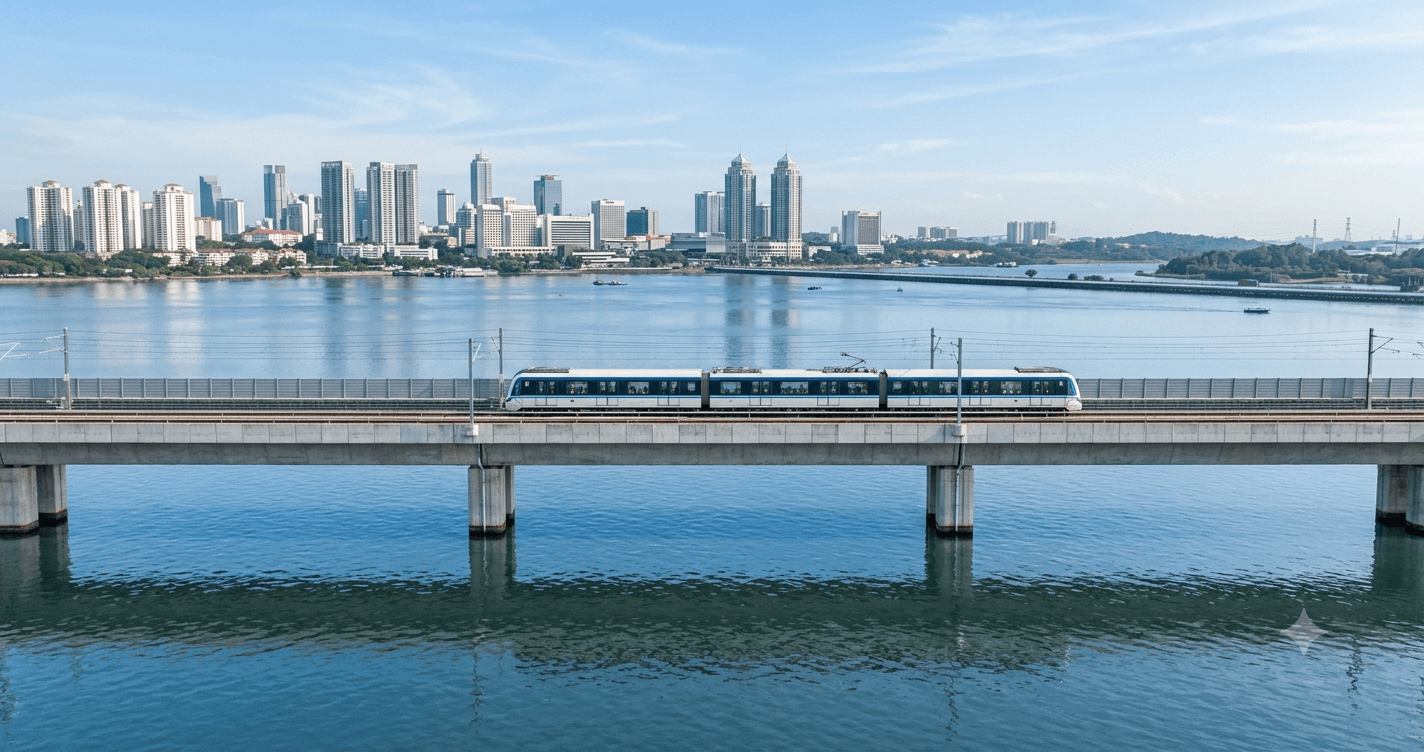
Five minutes across the Straits of Johor, from Bukit Chagar to Woodlands North — that is the ride the RTS Link promises when it opens in early 2027. The questions a JB commuter actually asks are more practical than the marketing: what will a trip cost, when does the first train run, and how many people can it move at 7:30 on a Monday? Here is what is settled, and what is still an estimate. For the stations and the route itself, see the route and stations map; this guide is about using the line.
RTS fares: what is set, and what is still a guess
Start with the honest answer: as of August 2026, no RTS Link fare has been officially set. The fare and the exact opening date will be announced jointly by the Malaysian and Singaporean transport ministers, and that announcement had not landed at the time of writing.
One figure is on the record, and it is an estimate. In February 2026 Transport Minister Anthony Loke said a one-way trip could sit around S$5 to S$7 — roughly RM15.50 to RM21.70 at the exchange rate then. Two things frame that number:
- RTS Operations — the SMRT–Prasarana joint venture that will run the line — is due to propose the actual fares in the second half of 2026, and both governments then approve them.
- Neither side plans to subsidise the fare, and the price is meant to work out the same whether you tap in with ringgit or Singapore dollars, matched at the prevailing rate.
So keep the S$5–7 band in mind as a planning number, but do not bank on it. Until the rate is gazetted, every "RTS fare" you read — this one included — is a placeholder.
Operating hours and how often trains run
The reported operating plan runs daily from about 6am to midnight. At peak, trains are expected roughly every 3.6 minutes; off-peak, about every 6 minutes. Read those as the operator's stated plan rather than a gazetted timetable — like the fare, the final schedule firms up closer to opening.
The frequency matters more than the five-minute crossing time. A train every 3.6 minutes means you stop timing your morning around a single departure: you walk onto the platform and the next one is already close. That is the practical break from the Causeway, where a bad morning is measured in the length of the bus queue, not the length of the ride.
Capacity: per hour, per day, and why it matters at 8am
The line is built to carry 10,000 passengers per hour in each direction, with expected ridership around 40,000 a day when it opens. For a daily commuter, the peak-hour ceiling is the number that counts. Ten thousand an hour, each way, on a dedicated cross-border shuttle is a different order of throughput from the mixed car, bus and motorbike crawl over the Causeway during rush hour.
It is not unlimited — a packed 8am train is still a packed train — but the RTS is designed to absorb the peak that the current crossings cannot. If you are weighing the two, the RTS versus Causeway comparison puts the daily numbers side by side.
How you actually ride it
The RTS is a two-station shuttle, so the trip is short. The sequence at opening is expected to work like this:
- Buy a ticket or tap in at Bukit Chagar — the operator plans to accept contactless bank cards and stored-value options, with details confirmed nearer launch.
- Clear immigration once. Bukit Chagar has a co-located CIQ, so you clear both countries at your departure station instead of queuing twice at the Causeway.
- Board and ride — about 5 minutes across the strait to Woodlands North, with no stops in between.
- At Woodlands North, transfer onto Singapore's Thomson-East Coast Line for the rest of your journey. The onward-connection guide maps the times to the CBD, Orchard and Jurong.
One clearance, one transfer, and you are on Singapore's rail network — the whole point of building a rail crossing instead of widening a road.
Budgeting the daily commute from a Bukit Chagar home
The commute cost is two numbers: the fare and, if you live on the JB side, your housing. Buy 300 m from Bukit Chagar station and the second number is a Malaysian mortgage, not a Singapore rent. SkyOne sits 300 m from the platform, is freehold, and starts from around RM628,000 for an entry Type A dual-key unit, with completion filed for November 2030. Because entry units fall below the RM1 million foreign-buyer floor, a Malaysian buys as a local — no state consent, no foreigner stamp-duty surcharge, full local financing.
Pair a to-be-confirmed fare in the S$5–7 range with a local-priced mortgage and the daily cost of living beside the line becomes something you can actually plan around. Run the monthly repayment on the installment calculator to see what a home 300 m from the platform costs you each month.
Keeping up as announcements land
Fares, the final timetable and the opening date all firm up through the second half of 2026, and this page updates as they do. For the full route and station reference, use the RTS Link guide; for whether the 2027 target is holding, follow the construction progress tracker.
The bottom line
Plan on a roughly S$5–7 fare, a 6am-to-midnight service every few minutes, a five-minute crossing and a single immigration clearance — with the fare and timetable still to be confirmed before the early-2027 opening. The commuters who gain the most are the ones already living beside the platform when the first train runs. See which SkyOne layout your budget carries — run the numbers on the installment calculator.