After Woodlands North: Your RTS Commute Into Singapore
Published on July 10, 2026·5 min read
Step off the RTS at Woodlands North and you're on Singapore's MRT. The onward ride to Orchard, the CBD and Jurong, and how to own where it starts.

Step off the RTS at Woodlands North and you're on Singapore's MRT. The onward ride to Orchard, the CBD and Jurong, and how to own where it starts.
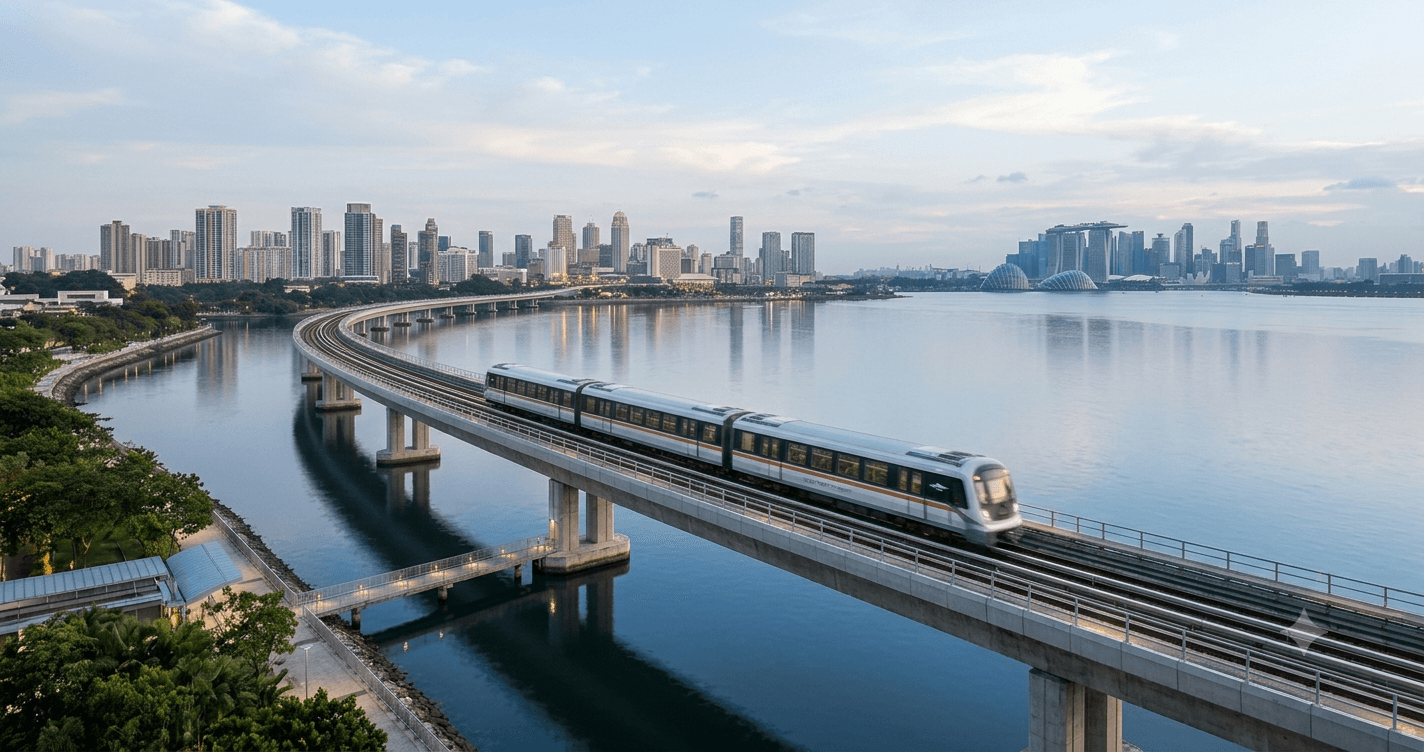
It is 7:15am. You tap through the e-gate at Bukit Chagar, clear both immigrations before your coffee is finished, and board. A few minutes later the doors open at Woodlands North — and you are already on a Singapore MRT platform. The RTS is only the crossing. The question that decides your morning is the next one: once you step off at Woodlands North, how do you actually reach your desk?
This is the onward map for a Malaysian who lives in Johor Bahru and works across the strait. For the full RTS reference — the line, the stations, the fares as they are confirmed — see our complete RTS Link guide. Here we pick up where that guide hands off: the Singapore side.
Woodlands North is not a new station waiting to be built. It has run as the northern terminus of the Thomson-East Coast Line (the brown line, or TEL) since January 2021, and the RTS platform is being connected directly to it. One stop south is Woodlands, which interchanges with the North-South Line (the red line). From Woodlands North the TEL then runs straight down the middle of the island toward Orchard, the CBD and Marina Bay, per the Land Transport Authority (accessed 10 July 2026).
So the moment you clear the RTS you are inside Singapore's MRT system — no shuttle bus, no taxi queue, no walk to a separate line. You transfer once, at most.
Where you land depends on which line your office sits on. The main routes from Woodlands North:
Journey times will firm up as the RTS opening nears; the TEL segments above already run today, so the onward leg is not a promise on a plan — it is a line you can ride this afternoon.
The reason the RTS feels fast is not just the short crossing. At Bukit Chagar, Malaysian and Singaporean immigration sit under one roof. You clear both before you board — there is no second checkpoint when you arrive at Woodlands North. The Star reported the Bukit Chagar Integrated Immigration, Customs and Quarantine complex will run 100 immigration e-gates, each clearing a commuter in about seven seconds (accessed 10 July 2026).
That single-clearance model is the whole point: it removes the double queue that defines the Causeway today. If you want the head-to-head against driving or the bus, read RTS vs the Causeway.
The RTS is a 4 km twin-track line worked by driverless four-car trains, built to move up to 10,000 passengers per hour in each direction and an expected ~40,000 riders a day at launch, per the project record (accessed 10 July 2026). At that capacity the trains arrive at short intervals through the peak, so the crossing is a turn-up-and-go ride, not a timetable you plan your morning around. Passenger service is targeted for January 2027; as of July 2026 the project was reported on track for that date.
Here is the part a Singaporean buyer cannot copy. You earn in Singapore dollars and spend in ringgit, and you buy your JB home as a local. That means no RM1 million minimum price, no State Authority consent, and the graduated 1–4% transfer stamp duty a citizen pays rather than the 8% surcharge a foreigner now carries (all rates current, verify at purchase). You also reach a higher loan-to-value margin and can tap your EPF for the down payment.
Put that against an SkyOne home 300 m from the platform where your commute begins, and the daily maths is plain: an SGD salary, a MYR mortgage, and a walk to the station instead of a causeway crawl. For what that gap looks like across rent, food and bills, see cost of living: JB vs Singapore, and for the commute itself, a day in the life on the RTS.
The commute only pays off if the home behind it adds up. SkyOne is freehold, 300 m from Bukit Chagar, from ~RM628,000 for an entry Type A dual-key, with filed completion in November 2030 — time to buy in before the line opens. Run the SGD-income, MYR-mortgage numbers on the installment calculator, then see which SkyOne layout fits your RTS commute and budget.
Discover more insights and updates about our premium development

Is Johor Bahru really cheaper than Singapore? A 2026 side-by-side on rent, food, healthcare and transport for anyone earning in SGD and living in JB.
Published on September 30, 2026 · 5 min read

How much can you borrow for a Johor Bahru home, and can EPF fund the deposit? A Malaysian's 2026 financing playbook — LTV tiers, KWSP withdrawal and DSR.
Published on September 28, 2026 · 8 min read
What happens to property near the RTS when Bukit Chagar opens in 2027? An evidence-led look at the proximity premium and which freehold units gain most.
Published on September 25, 2026 · 6 min read