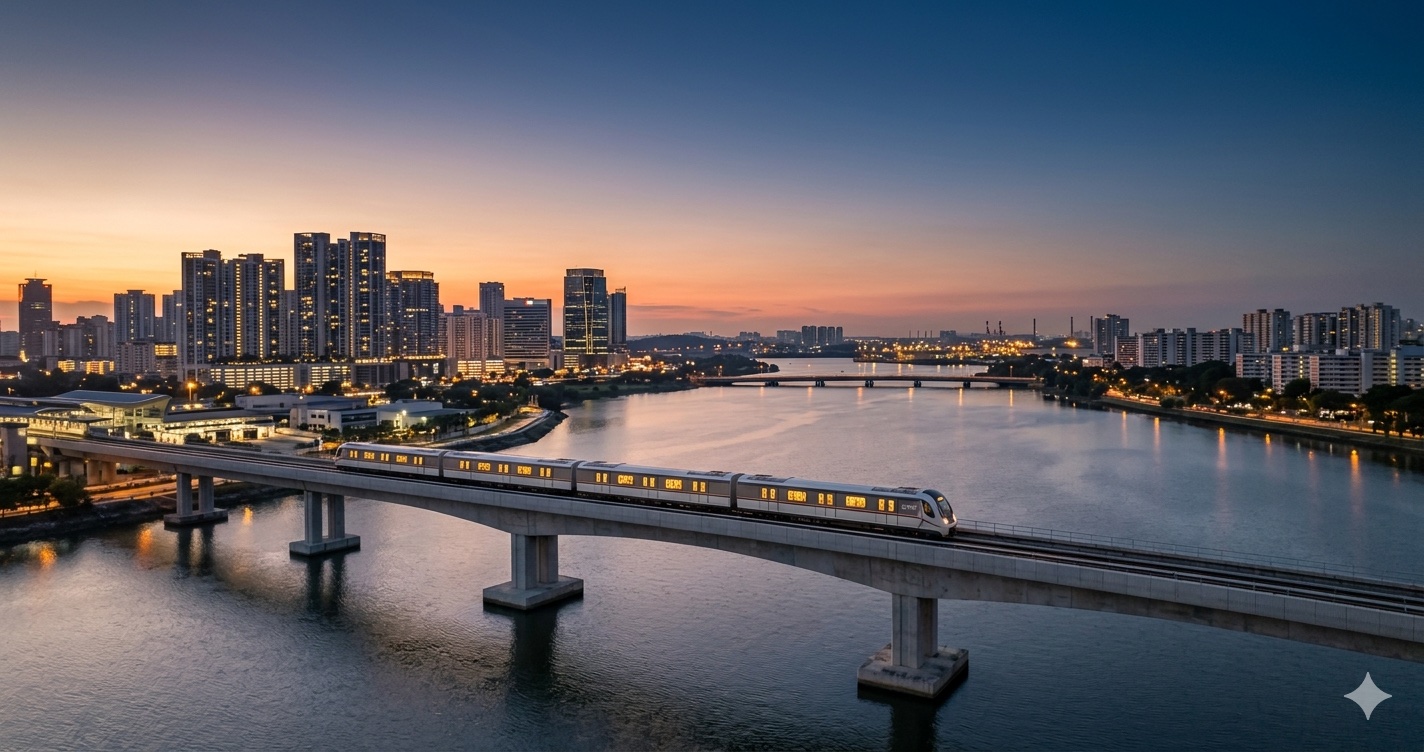
Summary
- The Causeway is the world's busiest land border. Woodlands Checkpoint handled around 327,000 travellers a day in 2024, and a typical crossing takes 45-90 minutes - rising past 2-4 hours at peaks and holidays.
- The RTS Link changes the maths. A 5-minute train ride between Bukit Chagar and Woodlands North, with capacity for up to 10,000 passengers per hour per direction, is targeted to begin passenger service by end-2026 into early 2027.
- Driving carries hidden costs. Since 1 July 2025, Singapore-registered cars need a VEP and pay a RM20 Road Charge on each entry to Malaysia, on top of tolls and fuel.
- Indicative RTS fares are RM15.50-RM21.70 (about S$5-7) per trip - figures cited by Malaysia's Transport Minister in February 2026, not yet finalised.
- What you save is time and predictability, which is exactly why walking distance to the station matters.
- Estimate your monthly repayment near the RTS →
Figures below are current as of June 2026. Cross-border fees, fares and timelines change - confirm the latest position with the official sources linked before you rely on a number.
The four ways to cross today
Before the RTS Link opens, every JB-Singapore commuter chooses between four options, each with its own trade-off of speed, cost and predictability:
- Drive via the Woodlands Causeway - the shortest distance and closest to JB city centre, but also the most congested.
- Drive via the Tuas Second Link - longer and further west, but often clearer; favoured by drivers heading to Iskandar Puteri and the western corridor.
- Cross-border bus (e.g. Causeway Link, SBS/SMRT services) - cheap and frequent, but you still queue at both immigration checkpoints.
- Motorbike - the fastest through the jam today because bikes filter to dedicated lanes, but exposed to weather and the same VEP rules.
The honest summary: today, none of these is fast and predictable at peak hours. That is the gap the RTS fills. For the precise route, stations and specifications, see our complete RTS Link guide.
The real cost of the Causeway commute: time lost to congestion
The Causeway is the busiest land border on earth. Daily traveller volume at Woodlands Checkpoint reached roughly 327,000 in 2024 - up about 22% on the year before - and volumes spike further on weekends and holidays. A routine crossing averages 45 to 90 minutes, but during weekday peaks, Friday evenings, Sunday nights and festive periods, queues regularly stretch beyond two to four hours.
The predictable pressure points are well known to anyone who does the run: weekday mornings roughly 6:30am to 9:00am heading into Singapore for work, and 5:30pm to 8:00pm returning to Johor. For a daily commuter, that congestion is not an occasional inconvenience - it is hours of life spent in a queue every week, and it is the single biggest reason proximity to the RTS commands a premium.
Enter the RTS: journey time and predictability
The Johor Bahru-Singapore Rapid Transit System (RTS) Link is a dedicated ~4 km shuttle line connecting Bukit Chagar station in JB with Woodlands North station in Singapore. According to Singapore's Land Transport Authority and Malaysia's MRT Corp (both accessed June 2026), the key specifications are:
- Journey time: about 5 minutes between the two stations.
- Capacity: up to 10,000 passengers per hour per direction.
- Service: a fleet of driverless four-car trains running at peak frequencies of around 3.6 minutes.
- Co-located CIQ: you clear both Singapore and Malaysia immigration at your departure station, so there is no second checkpoint mid-journey.
On timing: as of June 2026, the project is targeted to begin passenger service by the end of 2026, ramping into early 2027. Because the date has shifted before, treat it as a target rather than a guarantee and check the official sources for updates. What does not change is the structural point: a fixed-schedule, weather-proof train removes the variable that makes the Causeway so painful - unpredictability.
Cost comparison: tolls, fuel, VEP and bus fare vs the RTS
Speed is only half the decision; here is how the running costs stack up, current as of June 2026.
Driving
Since 1 July 2025, every Singapore-registered vehicle entering Malaysia must carry an activated Vehicle Entry Permit (VEP) RFID tag (a one-time RM10 tag, valid five years) and pay a RM20 Road Charge deducted from a Touch 'n Go account on each entry; driving without it risks an on-the-spot RM300 fine, per LTA's OneMotoring. On top of that come Singapore-side tolls (leaving via Woodlands is around S$0.80; a round trip on the Singapore side is roughly S$6.50), Malaysian tolls, fuel, and JB parking. Note too that Singapore has announced increases to VEP and Goods Vehicle Permit fees from 1 January 2027 - another reason to verify the current numbers.
Cross-border bus
The bus is the cheapest option: a Causeway Link CW1 trip from Kranji to JB is around S$2.60 (and about RM2.60 on the return leg), with buses roughly every 15-30 minutes. The catch is that you still queue at both CIQ complexes, so the fare is low but the time cost during peaks is not.
The RTS
Indicative RTS fares of RM15.50 to RM21.70 (about S$5-7) per journey were cited by Malaysia's Transport Minister Anthony Loke in February 2026; these are not yet finalised, so we are not stating them as confirmed. Even at the top of that range, the RTS sells a different product from the bus or the car: not the lowest fare, but the most predictable 5-minute crossing - no jam, no VEP, no parking.
Reliability and the peak-hour reality
The deciding factor for a daily commuter is not the average crossing - it is the bad day. A car or bus trip that takes 30 minutes off-peak can take three hours on a Friday before a long weekend, and you cannot plan a job around that variance. A train on a fixed timetable, clearing immigration once at the departure station, converts a wildly variable commute into a known quantity. That reliability - more than the headline 5-minute figure - is what re-rates property within walking distance of Bukit Chagar. See how the daily journey actually works at the JB-Singapore CIQ crossing.
Who benefits most
- Daily commuters working in Singapore - the clearest winners; predictable timing is worth more than a marginally cheaper fare.
- Weekend and family crossers - avoiding the Saturday-morning and Sunday-night gridlock without sitting in a car.
- Investors and landlords - the RTS widens the tenant pool to cross-border workers who want a short, reliable journey, which supports rental demand near the station.
The one common thread: the benefit is largest for people who can reach the station quickly. A 5-minute train is far less compelling if you first spend 25 minutes driving and parking to get to it.
What proximity to the station is worth
This is why the last few hundred metres matter. The RTS removes the cross-border delay; the walk to the platform is what is left. CTC SkyOne sits about 300 m from Bukit Chagar station, which means the whole door-to-door journey to Woodlands North can be measured in minutes rather than hours. Combined with its freehold tenure, that genuine walking distance to the RTS is the core of the proximity case.
If the commute is your reason to buy, model the numbers first: estimate your monthly repayment on a unit beside the station, then speak to us for a unit-specific walkthrough of life 300 m from the RTS.