JB Property for Retirement: A Cash Buyer's Playbook
Published on July 24, 2026·7 min read
Turn cash into retirement income: how a freehold, RTS-adjacent Johor Bahru condo pays you rent, grows over the hold and exits at 0% RPGT after five years.

Turn cash into retirement income: how a freehold, RTS-adjacent Johor Bahru condo pays you rent, grows over the hold and exits at 0% RPGT after five years.
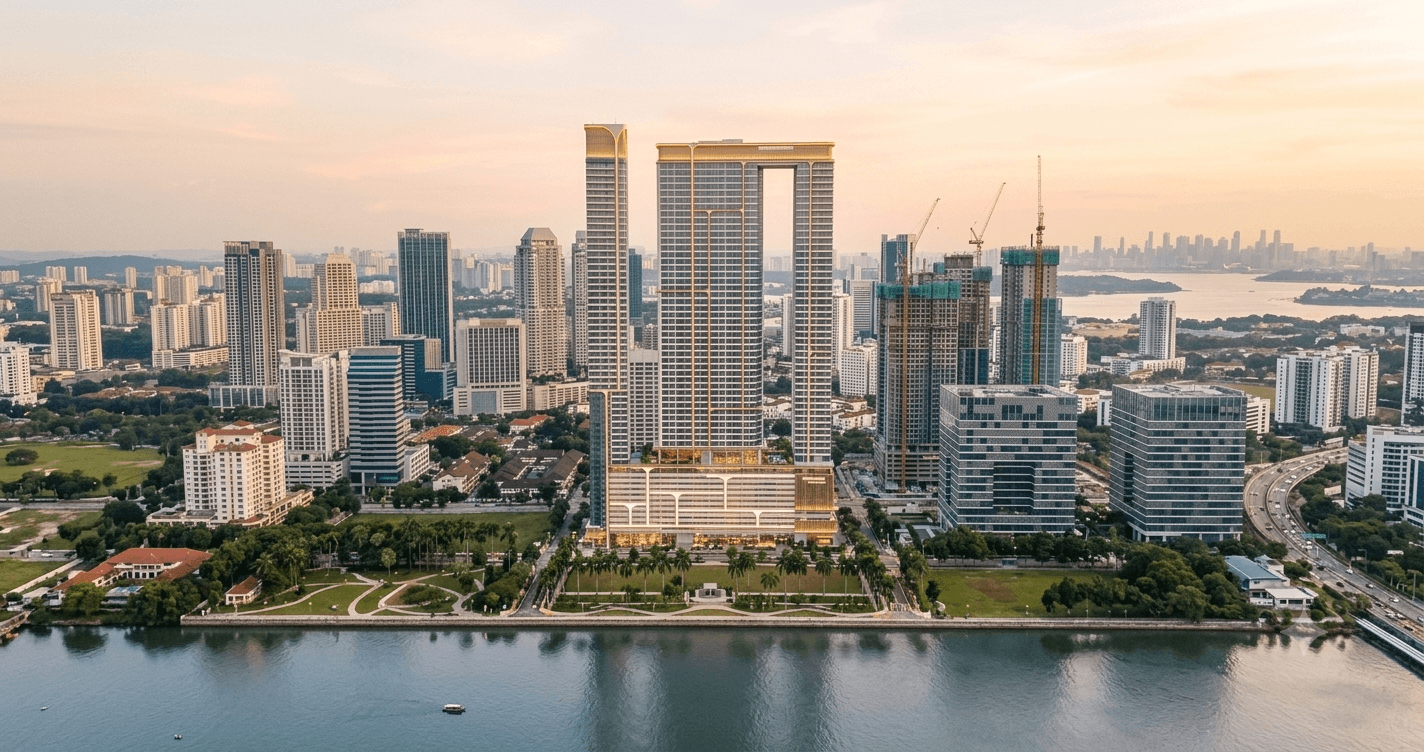
You have earned in Singapore dollars and spent in ringgit for years, and the cash has piled up. The question is no longer how to earn more. It is how to convert that cash into an income you still receive after the last payslip. A freehold condominium is one of the few assets a Malaysian can buy that pays a monthly cash flow, grows over a long hold, and can be lived in at the end. That last point matters: a retirement asset you can move into is worth more than a number on a statement.
This is a buy-and-hold plan, not a trade. The maths that follows assumes you hold for at least the five-to-six years that clear the exit tax, and more likely ten to twenty.
A financed buyer measures return on the deposit and worries about the gap between rent and the monthly repayment. A cash buyer has no repayment, so the rent — after costs — lands in your pocket. The number that matters is yield-on-cash: net annual rent divided by the total cash you put in.
Low gearing does three things for a retirement plan:
The trade-off is opportunity cost: cash locked in bricks is not earning elsewhere. That is why the yield and the appreciation runway both have to justify the hold.
Start with the gross yield, then subtract everything the brochure leaves out. Market data puts gross rental yields for well-located Johor Bahru city-centre and RTS-corridor condominiums at roughly 6–8%, above the national average of about 5.2% (Global Property Guide and IQI, mid-2026). Gross is not what you keep. For a realistic net figure, take out the monthly maintenance charge and sinking fund, quit rent (cukai tanah), assessment (cukai pintu), insurance, letting and management, and a vacancy allowance.
An illustrative example on the filed entry unit — a Type A dual-key, 463 sq ft, from about RM628,000 — bought with cash and let after handover:
Treat that as an illustration, not a promise — the actual rent depends on the unit, the fit-out and the market on the day. The point is the shape: a cash-bought, well-let city-centre unit can throw off a mid-single-digit net income once tenanted. For the full method and current ranges, see JB rental yields, with data, and for the cost lines you subtract, see the true cost of buying as a Malaysian.
Income is half the case; the other half is what the asset is worth when you exit or hand it on. Transit stations tend to re-rate the property around them, and the early signal is already visible in the rent: yields in the Bukit Chagar and RTS catchment run above the JB average, which is the market pricing in demand before the line opens in early 2027. The Johor–Singapore Special Economic Zone adds a second, slower demand driver over the hold.
Be sober about the forward view. Nobody can quote you a reliable future appreciation percentage, and any article that does is guessing. What is honest to say is that a freehold unit 300 m from a cross-border station, in a city centre that is adding jobs, has the demand drivers a long-hold retirement asset needs. For the evidence base and the risks, read the capital-appreciation outlook.
Most of the retirement case rests on time, and freehold is what lets time work for you. A leasehold title loses value as the lease runs down — a real drag over a fifteen-to-twenty-year hold and a problem when you pass it to your children. SkyOne is freehold, so there is no decay to fight and no lease to top up. You hold it as long as you like, retire into it, or leave it to the next generation intact.
When you do sell, Real Property Gains Tax is charged on the gain, not the sale price — and for Malaysian citizens the rate falls to zero if you hold long enough. The citizen schedule for an individual runs:
The current rates are published by the Inland Revenue Board (LHDN). A retirement hold clears the five-year mark comfortably, so a citizen selling from the sixth year keeps the whole gain. On top of that, a citizen can claim a once-in-lifetime exemption on the disposal of one private residence they have lived in — the full gain is exempt, with no cap, claimable once (Section 8, Real Property Gains Tax Act 1976). That is the case for eventually retiring into the unit rather than only renting it.
SkyOne's dual-key layouts fit the retirement plan neatly. Two lockable entrances behind one title mean you can run the unit three ways over its life:
One asset, one set of transaction costs, three income modes as your life changes. See how the dual-key play works for the layout detail.
If your savings sit in Singapore dollars, buying a ringgit asset converts a strong currency into a hard, income-producing one at home. You are moving cash out of a bank balance and into an unencumbered freehold that pays rent in the currency you will spend in retirement. The currency can move either way over a long hold, so treat the exchange rate as a factor to watch, not a guaranteed tailwind — but for a Malaysian who intends to retire in Malaysia, matching the asset to the spending currency is sound.
A retirement asset has to survive its own downside, so name it plainly:
The plan is only as good as your figures. Take the entry price, the gross-yield range above and the cost lines, and model your net yield-on-cash and hold on the installment calculator — then message us for a unit-specific projection built on the layout and floor you have in mind.
Discover more insights and updates about our premium development

Is Johor Bahru really cheaper than Singapore? A 2026 side-by-side on rent, food, healthcare and transport for anyone earning in SGD and living in JB.
Published on September 30, 2026 · 5 min read

How much can you borrow for a Johor Bahru home, and can EPF fund the deposit? A Malaysian's 2026 financing playbook — LTV tiers, KWSP withdrawal and DSR.
Published on September 28, 2026 · 8 min read

What happens to property near the RTS when Bukit Chagar opens in 2027? An evidence-led look at the proximity premium and which freehold units gain most.
Published on September 25, 2026 · 6 min read