Summary
- Five High-Performing Schools sit within about 4 km by road. Primary and secondary, national and Chinese-medium — an unusual depth of well-regarded schooling for one city-centre address.
- The preschools open at 8:00am, with drop-off from around 7:00am. That early window, not a school ranking, is what makes a Singapore commute workable for a parent.
- Foon Yew is about 3 km away — Malaysia's largest Chinese independent high school, founded in 1913.
- The accredited international schools are a drive, not a walk — 15 to 30 km out in Iskandar Puteri and Forest City.
- The real advantage is geography: school or preschool drop-off, then 300 m to Bukit Chagar RTS, which opens early 2027. The whole morning fits inside a few kilometres.
- See what a Bukit Chagar home costs you each month →
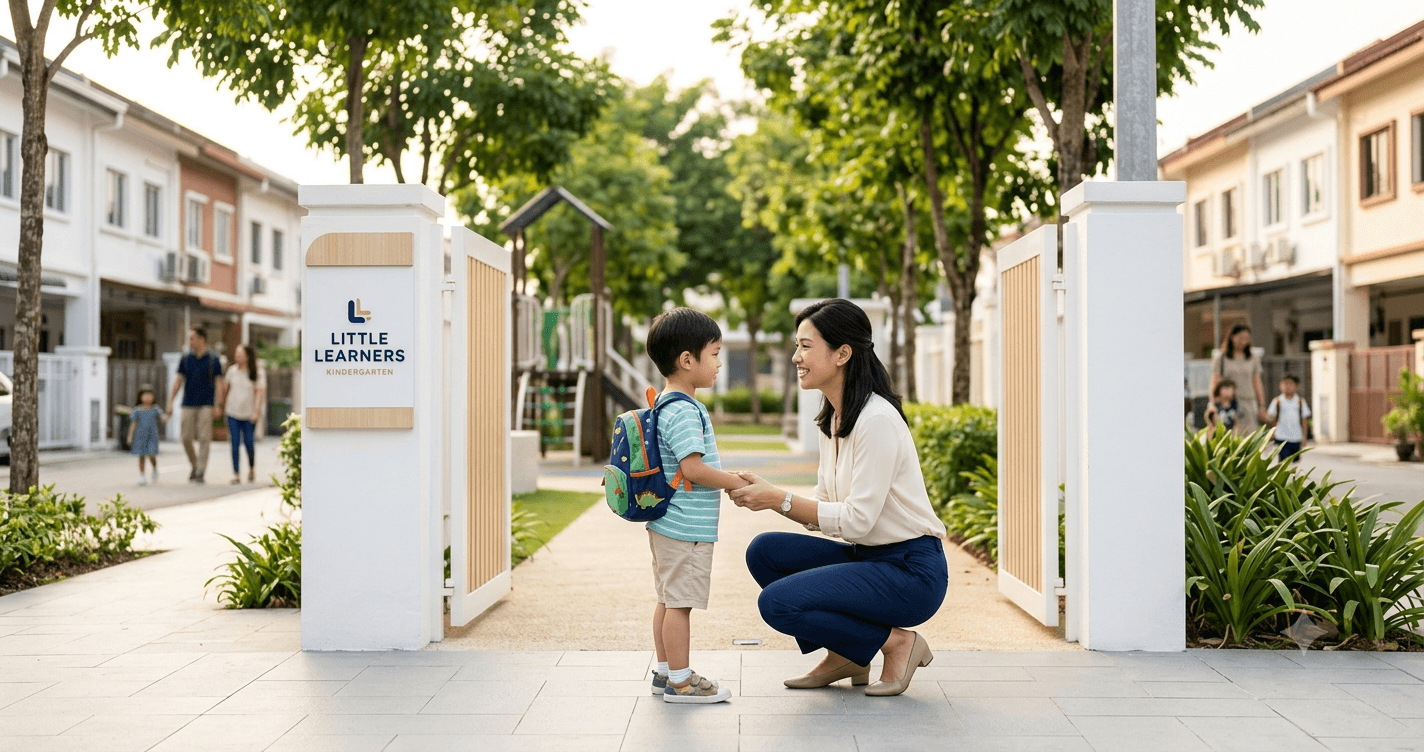
It's 7:05am. You drop your son at his kindergarten a few minutes up the road, and by the time the morning traffic thickens you are already back home, 300 m from the Bukit Chagar platform. For a family where one parent works in Singapore, that sequence — school, then the crossing — is the thing that decides where you live. This is an honest look at what sits inside that few-kilometre radius: the preschools first, because they are the binding constraint, then the schools, then the international options that are real but further out.
Preschools and childcare — the part that actually decides your morning
For a young dual-income family, the question is not which kindergarten tops a list. It is whether the doors open early enough for you to hand over your child and still clear the crossing before a 9am start. Most guides skip this entirely. Here are three centres near Bukit Chagar, with the fact that matters most — opening hours — first. Distances are by road.
- Littlesteps Kindergarten — about 2.2 km. Open 8:00am to 6:00pm, with drop-off from roughly 7:00am.
- Shambala Kidz Leadership Pre-School (Stulang) — about 3.0 km. Open 8:00am to 6:00pm, drop-off from roughly 7:00am.
- Tadika Bino — about 2.8 km. Open 8:30am to 6:30pm, drop-off from roughly 7:30am.
An 8:00am centre with a 7:00am drop-off leaves you the whole morning peak to make the crossing. Tadika Bino's later start is tighter, and worth saying plainly rather than averaging the three together. Early drop-off is usually a courtesy rather than a published service, and some centres charge for it, so confirm the arrangement with the centre when you enrol.
National schools in the catchment
The strongest honest claim this location has is the concentration of Sekolah Berprestasi Tinggi — High-Performing Schools, a Ministry of Education designation for schools that stand out across academics, character and co-curriculars. As of 2026, five of them sit within roughly 4 km of Bukit Chagar, spanning both school stages and both national and Chinese-medium streams. At primary level, SK (P) Sultan Ibrahim (about 3.6 km) and SK Infant Jesus Convent (about 3.2 km) carry the designation. At secondary level, SMK Sultan Ismail (about 3.6 km) and SMK Infant Jesus Convent (about 3.2 km) hold it.
The Infant Jesus Convent schools are the heritage anchor of the area: the Convent was founded in 1925, the first school of its kind in Johor, on land the Sultan gave for the purpose. The secondary school also carries a Sekolah Kluster Kecemerlangan (Cluster of Excellence) status — a separate Ministry programme, often confused with the High-Performing label, so worth naming precisely.
Two more national schools are closer still, without a special designation: SMK Dato Jaafar (about 1.7 km) and SK Ngee Heng (about 2.5 km). School designations are reviewed from time to time, so a school's current standing is always worth a quick word with the school itself.
Chinese-medium schooling: Foon Yew is on your doorstep
If you want a Chinese-medium path, this catchment is hard to beat. SJK(C) Foon Yew 2, a High-Performing primary school, is about 4 km away. It feeds toward Foon Yew High School — Malaysia's largest Chinese independent high school, founded in 1913, with its main campus at Stulang Laut, roughly 3 km from Bukit Chagar. Foon Yew runs the UEC track that many families choose for university options at home and abroad. Its distinction is scale and history, not a league-table rank, and that is exactly how it is worth weighing.
Vocational and tertiary options nearby
For a technical route, Kolej Vokasional Tanjung Puteri is about 1.6 km away — one of the closest institutions of any kind to Bukit Chagar. The wider JB city centre adds colleges and tertiary campuses within a short drive, so a child's path after secondary school does not force a move out of the area.
International schools — real, but a drive
The accredited international schools are genuinely good and genuinely not local. Plan for a 15 to 30 km drive, mostly westward toward Iskandar Puteri and Forest City:
- Marlborough College Malaysia (Iskandar Puteri) — a British day and boarding school teaching the UK curriculum to IGCSE then the IB, accredited by Cambridge International and a member of the international schools councils.
- British International School Johor Bahru (Nord Anglia Education).
- Raffles American School and Forest City International School, the latter following an American, NEASC-track programme.
These are a school-run destination in their own right, not a walk-and-drop. If an international curriculum is your priority, factor the daily drive into the decision the same way you would a mortgage.
The morning, mapped
Put it together and the reason this address works becomes concrete. A typical school-day morning for a commuting parent runs like this:
- Drop-off at a preschool or school within about 4 km — most open by 8:00am, several take children from around 7:00am.
- Back home, 300 m from the Bukit Chagar RTS platform.
- Onto the crossing to Singapore once the RTS Link opens in early 2027 — one immigration clearance at Bukit Chagar, then Woodlands North.
The RTS is not running yet, so any exact door-to-desk time today is a projection. What is fixed is the geography: home, school and station inside the same few kilometres. For how the rest of daily life sits around that, see the Bukit Chagar neighbourhood guide, and for families splitting healthcare and schooling across the border, the cross-border families guide.
What schooling costs over a childhood — and why some parents buy the asset first
School is a fifteen-year expense, and for many Malaysian families it runs alongside a university bill at the end. That long horizon is why some parents treat a city-centre property as the vehicle that funds it: buy a freehold home in an appreciating area, let it grow over a ten-to-eighteen-year hold, and exit tax-clean once the citizen Real Property Gains Tax drops to zero from the sixth year. Using a JB property as an education fund walks through that maths, and the JB cost-of-living guide sets it against a monthly family budget.
SkyOne fits that plan for a school-age family: freehold, from about RM628,000, 300 m from the Bukit Chagar RTS, completing November 2030 — a home you can raise children in and hold as the corridor matures.
Planning around a child's school timeline? Run your numbers on the installment calculator to see what a Bukit Chagar home costs you each month, then message us on WhatsApp for a layout that fits your family and your budget.